

The puja is done, the diya is still flickering, and two sticks of agarbatti are curling smoke up towards the ceiling fan. It smells like home. It's also late November, the windows have been shut all week against the smog, and that sweet haze has nowhere to go. So it's fair to ask: is agarbatti smoke harmful, or is this just one more thing to worry about?
The honest answer is that incense smoke is real smoke. In a small, closed room it adds fine particles and gases to the air you breathe, and how you burn it matters more than whether you do. You don't have to give up the ritual. A few small changes go a long way.
What's actually in agarbatti smoke?
An agarbatti is a bamboo stick coated with a paste of wood powder, resins, binders and fragrance. It smoulders rather than burning with a flame, and like most slow, incomplete burning it gives off:
- Fine particles (PM2.5). These are small enough to travel deep into the lungs. The blue-grey haze you can see is mostly particles.
- Volatile organic compounds (VOCs). Incense smoke can contain compounds such as benzene and formaldehyde, along with the fragrance chemicals themselves.
- Carbon monoxide. Smouldering produces some, as any incomplete burning does.
Mosquito coils smoulder the same way, except they burn for hours, often right next to the bed.
Is agarbatti smoke harmful? It comes down to the dose
One stick lit near an open window in a big hall is a very different thing from three sticks in a 10×12 bedroom with the door shut. The smoke is the same. The amount you breathe isn't.
Three things decide that amount:
- How much you burn. Each extra stick or cone adds to the load.
- How big and how closed the room is. A small room fills up fast, and with sealed winter windows the smoke can hang around long after the stick has burnt out.
- How often. A short burn once a day isn't the same as incense running every evening for hours, or a coil smouldering all night.
In winter, outdoor air in many North Indian cities already sits in the Poor or Very Poor AQI bands, so whatever the agarbatti adds comes on top of what has leaked in from outside. You can see what each band means with our AQI calculator.
A few myths, and what's true instead
"Natural or herbal agarbatti doesn't make smoke." Anything that burns makes smoke. Burning wood powder and resin still releases fine particles, whatever the label says.
"If I can't smell it any more, it's gone." Your nose gets used to a smell within minutes. The particles don't leave just because you've stopped noticing them.
"My air purifier takes care of it." A HEPA purifier sized for the room can help bring particles down, but it isn't designed to catch gases like VOCs. If you're not sure your purifier is keeping up, try the simple test in our guide to checking whether your air purifier works.
Who should be more careful?
Some people feel smoke more than others. Take extra care if someone at home:
- has asthma, bronchitis or another lung condition, since smoke is a common trigger for coughing and wheezing
- is a baby, a young child or elderly
- is pregnant
- gets headaches, a scratchy throat or watery eyes when incense is lit
If anyone has breathing symptoms that keep coming back, see a doctor and mention the incense and coils you use at home.
How do you keep puja time and cut the smoke?
None of this means skipping the evening aarti. It means burning a little smarter.
- Light one stick, not a bundle. One is usually plenty for the fragrance.
- Open a window or the door for 10 to 15 minutes while it burns and just after, even in winter. If you can choose, do it when outdoor AQI is lower, which in winter is often the afternoon.
- Put it out when the puja ends instead of letting it burn down in a shut room.
- Keep incense out of bedrooms, or at least don't burn it in a room someone is about to sleep in.
- Swap the mosquito coil for a net, window mesh or a plug-in repellent where you can, especially in a bedroom.
The same habits help with tadka smoke too, as our guide to cooking and indoor air explains.
Want to see it for yourself?
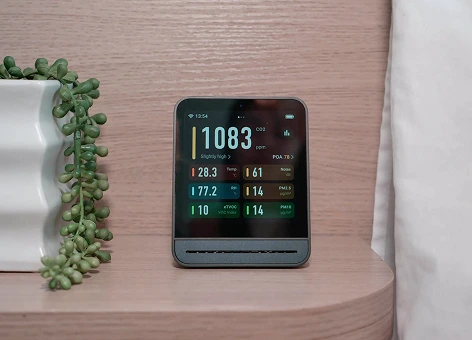
The quickest way to settle the question in your own home is to watch the numbers. Put an air quality monitor like the Oxyiot Mini in the room, note the PM2.5 reading, then light your usual agarbatti. Watch how fast it climbs, then try again with a window open and compare.
If you'd like to see VOCs as well, the Oxyiot Pro Touch shows TVOC alongside PM2.5 and CO₂. One thing to know: our monitors don't measure carbon monoxide, so they can't tell you about that part of the smoke. Fresh air is the answer there too.
Questions people ask about agarbatti smoke
Is it safe to burn agarbatti in a bedroom?
It's better not to burn it in a room just before someone sleeps there, especially with the door and windows shut. If you do, keep it to one stick and air the room out before bedtime.
Is agarbatti smoke harmful for babies?
Babies' lungs are still developing, so keep incense and coil smoke away from them. Burn it in another room with a window open, and let the air clear before they come back in.
Is dhoop better than agarbatti?
Not really. Dhoop and sambrani are still smoke, and they often make more of it than a single stick. Whatever you burn, a little of it in a well-aired room is the gentler choice.